
LSI exists to prepare people for an AI-augmented future and to play an active role in shaping it. That means exploring what technological progress makes possible, challenging established assumptions, and developing better ways to educate and support learners.
Research, scholarship and professional development are central to this work. They help LSI generate new knowledge, engage critically with existing evidence, strengthen academic practice, and build the capabilities needed for sustained innovation.
This strategy sets LSI’s research direction for 2027 to 2030. It identifies the areas where we aim to build distinctive expertise, explains how research and scholarship will contribute to educational innovation, and sets out how this work will be governed, supported and evaluated.

Research focus
LSI will build a focused research programme on how AI can be designed and applied to enhance higher education. The programme will explore new possibilities without assuming AI will automatically improve higher education.
The ambition is to turn strong research into novel, evidence-backed applications of AI for higher education.
The programme asks: What becomes possible with AI? What creates educational value? Under what conditions?

Governance
The Board of Governors approve the strategy, oversee its alignment with LSI's wider strategic direction, and review progress against its measures of success.
The President through Executive Committee, is accountable for delivery of the strategy, including appropriate resourcing, cross-functional coordination and achievement of its intended outcomes. The President will provide progress reports each semester to the Board of Governors, the Academic Board and Quality, Audit, and Compliance Committee, structured around agreed success measures and supported by evidence from research outputs.
The President is responsible for managing the research portfolio, coordinating the three strands, overseeing the annual planning and review cycle, and reporting progress.
The Academic Board provides academic oversight, including research quality, ethics, academic standards and scholarly integrity. They shall do so through a Research Ethics Committee that reviews ethics submissions.
The QCAC would provide assurance that the strategy is being implemented within effective governance and risk frameworks, such as data protection, regulatory compliance, funding risks and conflicts of interest.
The Prevent Lead will be consulted where sensitive and Prevent-sensitive research is identified and will support LSI’s sensitive research controls and briefings.
Relevant academic, technology and professional teams will contribute to research and innovation where appropriate, while researchers retain responsibility for the design, analysis and interpretation of their research.
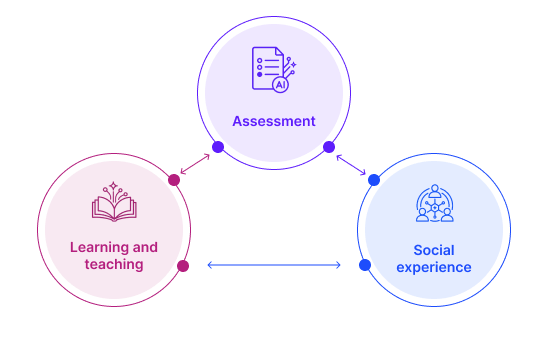
Central research question
How can AI applications be designed and adopted to enhance higher education?
This question will be engaged with in three research strands:
- AI in learning and teaching in higher education
- AI in assessment in higher education
- AI in social experience of higher education
The three strands examine different parts of the same educational system. Changes in one will create questions for the others. Researchers will therefore lead distinct strands while collaborating on cross-cutting opportunities. No strand is subordinate to another.
AI in learning and teaching in HE
Research question: What new and better approaches to learning and teaching become possible through AI?
Areas of inquiry may include: AI-supported teaching and tutoring, personalised and adaptive learning, feedback, explanation and practice, human–AI collaboration, student agency and independent judgement, development of knowledge, skills and capability, new pedagogical models, the changing role of educators, dependency and unintended effects.
The focus is on discovering new ways of teaching and learning that AI makes possible, not on adding AI to existing practice.
AI in Assessment in HE
Research question: What new forms of assessment become possible through AI, and how can they validly evidence learning and capability?
Areas of inquiry may include: formative and continuous assessment, new models of summative assessment, assessment of process as well as output, evidence of individual capability, authenticity, authorship and academic integrity, AI-supported feedback and evaluation, adaptive assessment, human judgement, fairness, bias and consistency.
The focus is on whether AI enables more meaningful ways to assess learning and capability, not just more efficient assessment.
AI in social experience of HE
Research question: How can AI enhance the social and relational experience of higher education?
Areas of inquiry may include: Peer learning and collaboration, community and belonging, dialogue and debate, mentorship and support, trust and academic relationships, identity, participation and inclusion, human–AI interaction in social settings, the changing social role of educators, the balance between personalised and collective experiences.
The focus is on new ways to strengthen the human and social experience of higher education through, alongside, or in response to AI.

Research team
LSI will appoint three researchers of comparable standing, each leading one strand. External academics will provide independent challenge, review and connection to wider research communities.
- AI in learning and teaching in HE: Expertise in pedagogy, learning sciences, educational technology and AI in education.
- AI in assessment in HE: Expertise in assessment theory, educational measurement, academic standards and AI-supported assessment.
- AI in social experience of HE: Expertise in sociology or anthropology of education, social learning, student experience and identity.
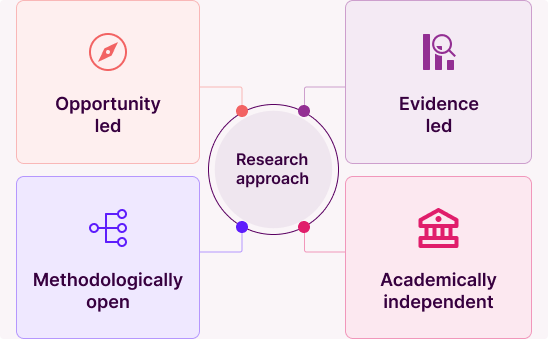
Research approach
LSI will keep educational value at the centre of inquiry. It gives researchers the freedom to follow the question, test assumptions rigorously and let evidence shape the conclusions.
- Opportunity led: Starting from an educational opportunity or problem, not with a technology looking for an application.
- Evidence led: Proposed applications of AI must be tested for their benefits, limitations and unintended consequences.
- Methodologically open: Methods will follow the question.
- Academically independent: Findings may support or challenge LSI's assumptions and practices.

Research scope
The programme covers higher education broadly, including: undergraduate and postgraduate education, professional and executive education, online, blended and campus-based models, different disciplines and institutions, diverse student populations, links between education and professional practice
LSI will provide an important research and experimentation environment, but studies may involve other institutions and contexts.
Generative AI will be an initial priority, alongside emerging technologies such as AI agents, intelligent tutoring, adaptive learning and AI-supported assessment.
Each study will define the technology and educational context it examines.

LSI's role
To enable this research strategy, London School of Innovation will provide: research funding and time, access to educational, environments, research governance and ethics, opportunities to design and test new applications, collaboration with academic and technology teams, support for external research partnerships.
LSI offers an unusual opportunity to connect academic research, educational practice and technology development. Research independence will be protected, while strong findings can move into experimentation, validation and innovation.

Intended contribution
Over three years, LSI aims to create a portfolio of novel, evidence-backed applications of AI for higher education.
These may include new teaching and learning methods, new forms of assessment, new social and collaborative experiences, new combinations of AI and human activity and new educational models, frameworks and technologies. The programme will also contribute to scholarship through publications, research collaborations and wider academic engagement.
Research that demonstrates that an approach does not work, works only in particular circumstances, or creates unintended harm remains valuable. It prevents weak ideas from becoming educational practice and informs subsequent innovation.
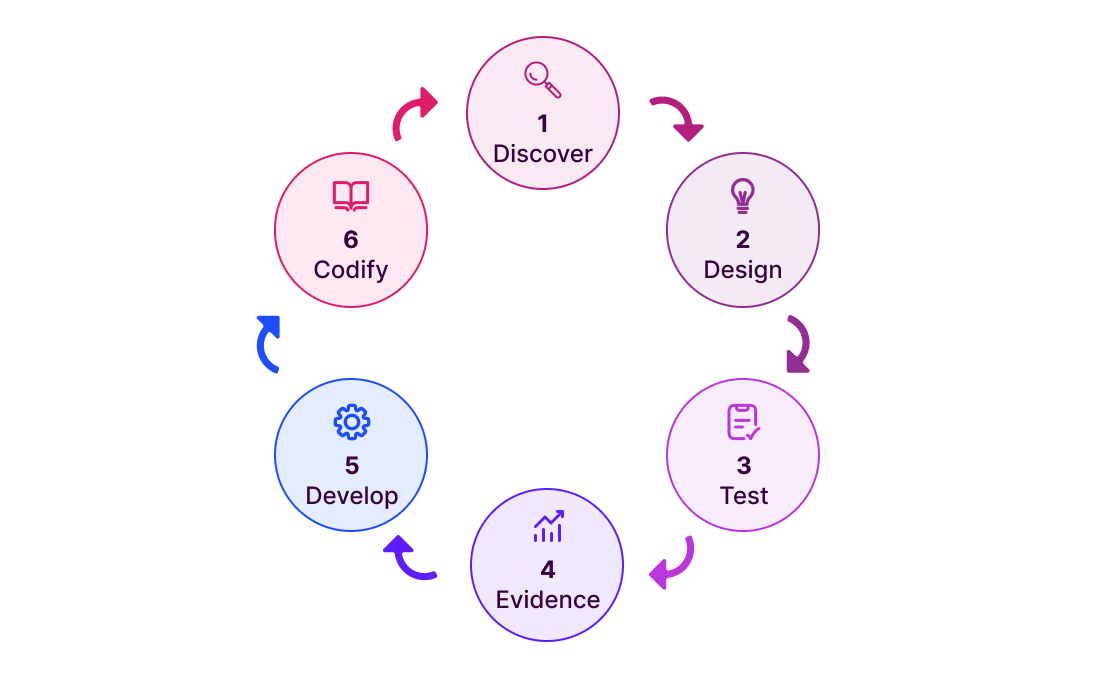
Delivery model
The programme will operate as a continuous cycle:
- Discover: Identify important opportunities through research, evidence and emerging AI capabilities.
- Design: Develop a new educational method, model or application.
- Test: Apply it in an appropriate higher education setting.
- Evidence: Measure its educational and human outcomes.
- Develop: Refine, scale, stop or redirect the application based on the findings.
- Codify: Capture successful innovations as transferable methods, frameworks, technology or IP.
Each strand will maintain a pipeline of opportunities at different stages of this cycle. Over time, the strongest ideas should progress from research questions to validated educational innovations.

Planning and review
The programme will operate through an annual planning and review cycle that include four stages: Review, Prioritise, Research and test, Annual synthesis
External academics will contribute independent challenge to the review. The result will be a rolling research and innovation portfolio: structured enough to build cumulative knowledge, but agile enough to respond to rapid changes in AI and higher education.
- Review: evidence from current and completed studies, progress of applications under development, changes in AI capabilities, emerging higher education challenges and opportunities, external research and sector developments. Existing projects will be continued, adapted, scaled or stopped based on the evidence.
- Prioritise: each strand will identify the research opportunities with the greatest potential to create meaningful educational value. Priorities will consider: significance of the opportunity, originality, potential depth of impact, strength of the research question, feasibility of testing, potential for transferable knowledge or IP. A balanced portfolio will be agreed across the three strands.
- Research and test: Researchers will pursue the agreed priorities through appropriate research and experimentation. Projects may be at different stages: exploration, design, testing, validation or scaling. New opportunities may enter the programme during the year where developments in AI or emerging evidence justify doing so.
- Annual synthesis: At the end of each cycle, LSI will review: what has been learned, which applications have demonstrated positive outcomes, the depth and reliability of those outcomes, which ideas should be stopped or reconsidered, new methods, models or IP created, priorities for the next cycle.

Measures of success
The programme will be judged primarily on validated innovation and depth of impact.
Validated Innovation: How many novel applications of AI has the research enabled LSI to create with evidence of positive educational outcomes?
Depth of Impact: How significant are the positive outcomes created by those innovations?
Validated Innovation may include new teaching and learning methods, assessment methods, social and collaborative experiences, educational models, technologies, associated intellectual property. An innovation counts as validated only when credible evidence demonstrates positive outcomes.
Depth of Impact may include improvement in learning and capability, teaching effectiveness, assessment validity, student agency and judgement, engagement and participation, belonging and relationships, collaboration, accessibility and inclusion, educator effectiveness. Depth of impact will consider the size, consistency and durability of the improvement, including how it varies across learners and contexts.
Academic quality, publication and external collaboration remain important because they strengthen the evidence, credibility and reach of the programme. The ultimate measure of success is whether LSI's research creates new, proven ways to make higher education better through AI.

Research, scholarship and CPD
LSI sees research, scholarship and CPD as distinct but connected activities that strengthen academic practice and innovation.
Scholarship may generate questions for research, while research may inform scholarship and practice. Where scholarly activity uses research methods to generate or analyse data in support of evidence claims, it will be treated as research for ethics, data protection and governance purposes.
- Research: systematic inquiry that generates new or substantially new insights or evidence. This includes applied evaluation, technical development and pedagogic research.
- Scholarship: critical engagement with existing research, theory and professional or sector practice to maintain academic currency and improve curriculum, teaching and assessment.
- CPD: knowledge and capability that enable staff to engage effectively in scholarship, research and educational innovation.

LSI Exchange
Discover the people, ideas and conversations developing around LSI’s research through LSI Exchange, our open academic community connecting researchers, academics, students, practitioners and external contributors.