
100% Online
£895
10 weeks (4hrs weeks)
Certificate (on completion)
Applied GenAI in Legal Practice
Course Overview
The 'Generative AI and Prompt Engineering for Lawyers' module offers participants a comprehensive understanding of how mastering the art of prompt engineering can yield significant benefits in various aspects of legal work. By learning to skilfully craft prompts, participants can harness the potential of generative AI to transform processes such as evidence gathering and legal research, expediting discovery and staying current with legislative updates. In drafting and litigation, participants equipped with prompt engineering can efficiently construct legal documents and navigate complex cases, as AI assists in forming cogent arguments and identifying precedents. Managing legal cases becomes more streamlined, with AI analysing case details and predicting outcomes, thus enabling participants to offer strategic advice. Moreover, the ability to personalise client services through AI enables a new level of tailored communication, enhancing client satisfaction and retention. This module addresses the challenges inherent in integrating AI into legal practice, providing strategies to leverage generative AI ethically and effectively while exploring operational best practices. Participants who adeptly utilise prompts within AI systems position themselves at the forefront of legal innovation, driving value for clients and differentiation in a competitive market.
What you will learn
Through the following chapters you will master the Applied GenAI in Legal Practice
This chapter traverses the development of artificial intelligence, highlighting key examples and offering a straightforward explanation of how AI operates to lay the foundation for its application in legal settings. Big data analytics, machine learning, and data mining are introduced in this chapter.
|
This chapter generally introduces generative AI, tracing its use and detailing its function in generating new, contextually aligned content, forming a crucial step in technology-assisted law. Natural language generation, text generation, and GPT-3 are considered.
|
This chapter demystifies prompt engineering, providing general techniques for formulating effective prompts and refining them to achieve precise outcomes. It looks prompt design, effective prompts, and prompt engineering strategies.
|
This chapter examines the use of AI and prompts in discovery, assisting lawyers in efficiently collecting client information and navigating evidence, enhancing the fact-finding process. Text analytics in legal documents, litigation support tools, and natural language processing (NLP) are considered.
|
This chapter focuses on how AI and prompts are employed to research legal statutes and case law, ensuring lawyers stay ahead of legislative changes. Generative legal precedent analysis, OpenAI GPT models in Legal Tech, and case law databased are examined.
|
This chapter explores generative AI and prompt engineering's transformative impact on drafting legal documents and its emerging roles in advocacy, negotiation, litigation, and dispute resolution. Prompt design, generative AI in legal drafting, and document assembly are considered.
|
This chapter addresses how AI and prompts are reshaping case management, billing procedures, and enhancing communication channels within legal practices. Chatbots and virtual legal assistants, legal document templates, e-Discovery tools are considered.
|
This chapter delves into the integration of AI and prompts in personalising client experiences, providing superior service through technology-mediated interactions. Prompt engineering for client interaction, client retention through AI, and AI-assisted client communications are looked at in this chapter.
|
This chapter identifies the limitations of AI and prompts in law, proposing solutions to bridge the gap between current AI capabilities and the complex needs of legal practice. Generative AI ethics guidelines, cybersecurity in legal tech, and certification of AI systems are central in this chapter.
|
This chapter reviews the methods and mechanics of deploying AI strategically and in legal operations, examining manual to sophisticated integrations for enhanced service. It looks at legal operations, legal workflow optimisation, prompt engineering for legal AI, and global AI ethics standards.
|
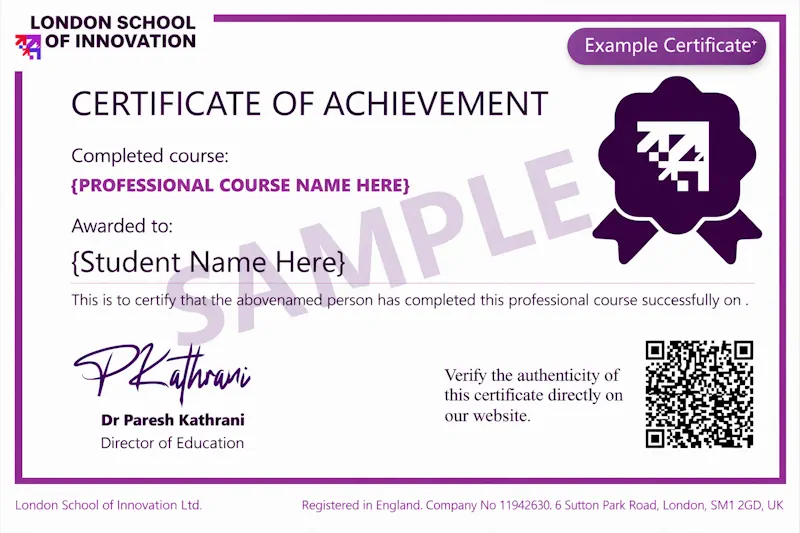
Certificate of Achievement
Upon completion, you will receive a recognised certificate from LSI (verifiable via QR code), along with a link to add it directly to LinkedIn and upgrade your professional presence.
Why study at LSI?
Traditional higher education hasn't kept pace with how fast the world is changing. LSI is different: built around technology, innovation and entrepreneurship, and designed to help you thrive in a future shaped by AI.
Specialist in
tech & innovation
As a UK higher education institution dedicated to digital tech, innovation and entrepreneurship, LSI optimises your path to mastery and confidence.
We don't try to be everything to everyone. Our curriculum, our teaching, our faculty and our culture are all built around a single aim: helping you become a capable, well-rounded leader in an AI-augmented world.
Regular
one-to-one support
Instead of one-way lectures, LSI gives students regular one-to-one academic contact, because the hardest parts of learning often need conversation, challenge, reassurance, and judgement.
Studying at postgraduate level is intellectual, but it is also personal. Motivation, confidence, uncertainty, and ambition all matter.
A network of
ambitious peers
You'll study alongside ambitious, curious people. Those relationships rarely end at graduation.
Your peers and the wider LSI alumni network become collaborators, sounding boards, and the contacts who open doors long after you've finished.
AI-enhanced
learning
LSI’s award-winning AI platform acts as a 24/7 learning companion, helping you work through material, test your understanding, receive formative feedback, and identify gaps earlier.
The system provides multimedia explanations, interactive tasks, formative checks, and feedback on your work, while academic staff remain responsible for judgement, standards, and support.
Your learning journey enhanced with AI
LSI's award-winning proprietary technology uses AI to personalise study, give faster formative feedback, and support practice, while human academics focus on discussion, judgement, mentoring, and academic standards.
Virtual
private tutor
This isn’t a chatbot. It’s a tutor that guides you through hands-on learning, at your pace. Read, watch or listen anytime, on your phone during a commute or workout, or on your laptop at 2am before a deadline.
Through text, audio, visual feedback, formative questions, and assignment critique, the tutor helps you keep moving between scheduled sessions with academic staff.
Master
the theory with AI
Every lesson adjusts to your pace and what you already know, so you're never stuck on the obvious or lost in the difficult.
Most subjects don't run in a straight line. Our Interactive Knowledge Graph maps how concepts connect and build on each other, then tracks what you've mastered and what still needs work, so nothing important slips through the cracks.
Instant feedback
for assignments
Get useful feedback the moment you submit, instead of waiting days to find out where you went wrong, then act on it while the work is still fresh in your mind.
This doesn't replace your tutors or academic judgement. Detailed feedback from faculty can be requested right after AI feedback. What it adds is momentum: you keep moving forward instead of stalling between submission and review.
Role-play
with AI
Rehearse the high-stakes moments before they're real. In AI-driven role-play, you make decisions in lifelike professional scenarios and see how they play out, so you build confidence where it's safe to get things wrong.
Judgement comes from practice, not theory alone. You might lead a tense project review, work through an ethical AI dilemma, negotiate a technical trade-off, or troubleshoot a system failure against the clock, each scenario repeatable and tied to what you're learning.
FAQs
Other courses you might be interested in
Latest insights
Read our latest thinking, exploring the forces reshaping education, work, and leadership in an AI-driven world. Our aim is to help leaders anticipate change, make confident strategic choices, and build organisations ready for continuous digital evolution.