
100% Online Study

£1,495

6 weeks (4hrs / weeks)

Certificate (on completion)
AI in Public Service
Making AI work for people with confidence and integrity
As we stand on the brink of a technological revolution, AI is emerging not just as a tool but as a transformative force reshaping our public institutions.
This course is specifically designed for senior leaders and managers in public sector organisations. With societal expectations surrounding AI running high, it is crucial for them to make informed decisions that balance innovation with integrity. Understanding AI’s potential, threats, and opportunities is essential to making it work for people.
This course addresses this pressing need, offering a comprehensive understanding of AI’s opportunities for public good as well as ethical dimensions. It prepares you to master this essential subject and become a forward-thinking and trusted leader capable of steering your organisation through this pivotal era in human history.


Course Overview
This course equips you to navigate the transformative role of AI in public service, blending foundational knowledge, practical applications, and ethical considerations. You’ll gain a deep understanding of AI’s capabilities, limitations, and its potential to revolutionize governance and public service delivery.
You’ll explore how AI has evolved, its core concepts, and its current technological landscape. Learn to design workflows that balance AI efficiency with human oversight, leveraging its strengths while managing risks. Through real-world case studies, you’ll discover how AI enhances equity, efficiency, and accessibility across public sectors.
The course also addresses critical ethical and societal issues, such as bias, fairness, transparency, privacy, and workforce transformation. You’ll understand the regulatory frameworks that guide responsible AI use, enabling you to make informed decisions that balance innovation with accountability.
By combining theory, practice, and ethical guidance, this course prepares you to harness AI effectively and responsibly, empowering you to drive meaningful improvements and navigate AI’s impact on public services with confidence.
Who is this course for?
Ethics Committees

Managers and Team Leaders

What you will learn
Through the following chapters you will master the AI in Public Service

Explore the fundamental principles of AI, its core concepts, applications, evolution and historical context.
|

Attain a grounded view of AI's real-world capabilities and boundaries. Gain insights into the current state of AI technology, examining its strengths, limitations, and areas where it either falls short of, matches, or surpasses human intelligence. Explore which tasks AI can handle autonomously, which require human oversight, and which remain beyond its reach.
|

Understand how workflows should be designed to balance AI efficiency with human oversight to mitigate risks. Explore smart escalation methods for managing routine tasks with quality assurance through human review. Discover AI's potential in ideation and brainstorming while recognising its creative limitations.
|

Explore how AI can improve governance and empower the citizens. Learn how AI can simplify access, personalise support, ensure fairness, promote equity in public services, boost efficiency, scale delivery, and drive continuous improvement.
|

Discover how to leverage AI to enhance public sector efficiency and impact. This chapter is packed with practical examples, revealing AI's potential to drive meaningful improvements in public services. Explore case studies of successful AI applications across public administration, healthcare, education, and more, along with insights into future possibilities.
|

Explore AI's ethical challenges, including bias, fairness, transparency, and privacy, within the context of evolving regulatory frameworks. Examine how laws and standards guide responsible AI deployment in public service, balancing innovation with accountability. Understand AI's societal impacts, particularly workforce transformation, addressing job displacement, reskilling, and new opportunities to ensure equity and inclusion.
|
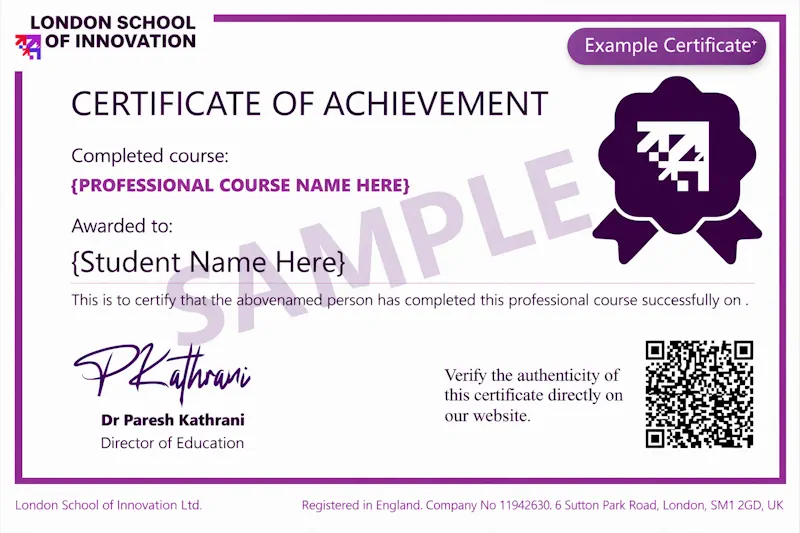
Certificate of Achievement
Upon completion, you will receive a recognised certificate from LSI (verifiable via QR code), along with a link to add it directly to LinkedIn and upgrade your professional presence.
Why study at LSI?
Traditional higher education hasn't kept pace with how fast the world is changing. LSI is different: built around technology, innovation and entrepreneurship, and designed to help you thrive in a future shaped by AI.
Specialist in
tech & innovation
As a UK higher education institution dedicated to digital tech, innovation and entrepreneurship, LSI optimises your path to mastery and confidence.
We don't try to be everything to everyone. Our curriculum, our teaching, our faculty and our culture are all built around a single aim: helping you become a capable, well-rounded leader in an AI-augmented world.
Regular
one-to-one support
Instead of one-way lectures, LSI gives students regular one-to-one academic contact, because the hardest parts of learning often need conversation, challenge, reassurance, and judgement.
Studying at postgraduate level is intellectual, but it is also personal. Motivation, confidence, uncertainty, and ambition all matter.
A network of
ambitious peers
You'll study alongside ambitious, curious people. Those relationships rarely end at graduation.
Your peers and the wider LSI alumni network become collaborators, sounding boards, and the contacts who open doors long after you've finished.
AI-enhanced
learning
LSI’s award-winning AI platform acts as a 24/7 learning companion, helping you work through material, test your understanding, receive formative feedback, and identify gaps earlier.
The system provides multimedia explanations, interactive tasks, formative checks, and feedback on your work, while academic staff remain responsible for judgement, standards, and support.
Your learning journey enhanced with AI
LSI's award-winning proprietary technology uses AI to personalise study, give faster formative feedback, and support practice, while human academics focus on discussion, judgement, mentoring, and academic standards.

Virtual
private tutor
This isn’t a chatbot. It’s a tutor that guides you through hands-on learning, at your pace. Read, watch or listen anytime, on your phone during a commute or workout, or on your laptop at 2am before a deadline.
Through text, audio, visual feedback, formative questions, and assignment critique, the tutor helps you keep moving between scheduled sessions with academic staff.

Master
the theory with AI
Every lesson adjusts to your pace and what you already know, so you're never stuck on the obvious or lost in the difficult.
Most subjects don't run in a straight line. Our Interactive Knowledge Graph maps how concepts connect and build on each other, then tracks what you've mastered and what still needs work, so nothing important slips through the cracks.

Instant feedback
for assignments
Get useful feedback the moment you submit, instead of waiting days to find out where you went wrong, then act on it while the work is still fresh in your mind.
This doesn't replace your tutors or academic judgement. Detailed feedback from faculty can be requested right after AI feedback. What it adds is momentum: you keep moving forward instead of stalling between submission and review.

Role-play
with AI
Rehearse the high-stakes moments before they're real. In AI-driven role-play, you make decisions in lifelike professional scenarios and see how they play out, so you build confidence where it's safe to get things wrong.
Judgement comes from practice, not theory alone. You might lead a tense project review, work through an ethical AI dilemma, negotiate a technical trade-off, or troubleshoot a system failure against the clock, each scenario repeatable and tied to what you're learning.

FAQs
LSI courses are delivered 100% online based on a flipped learning approach. Students engage with theory through LSI's AI-powered Virtual Learning Environment at their own pace, supported by a 24/7 AI virtual tutor to develop their knowledge. The core learning content is provided in various formats, including video, reading mode, audio-only, or dialogue mode, depending on the preferences and personal learning style of every student.
This is then followed by one-to-one time with human professors, online meetings with fellow students for discussions and collaborative problem-solving, and applying knowledge to real-world challenges.
Formative assignments and challenges are integrated into the learning process at every stage, with a diverse range of activities, including traditional quizzes but also AI-powered socratic questioning, self reflections, hands-on assignments, simulations and role-play.
It is designed to join the best of the two worlds for maximum educational attainment: human-touch and comradery, with limitless hyper-personalised, contextualised and dynamic learning content and AI support.
The academic year at the London School of Innovation is structured into three semesters, each spanning four months:
- Semester 1: Begins around 1 February and ends in late May.
- Semester 2: Begins around 1 June and ends in late September.
- Semester 3: Begins around 1 October and ends in late January.
All programmes at the School commence at the start of each semester. For specific dates and further details, please refer to the School Calendar and Semesters Policy on our website.
When considering short courses, it's essential to understand the type of short course and entry criteria, as outlined in our Short Courses (Non-Credit and Credit-Bearing) Regulations. These criteria are designed to ensure that all participants can make the most of the short course that they wish to undertake.
For Executive Education short courses, we generally seek individuals in senior leadership or management roles who possess significant experience or relevant qualifications. These courses are tailored for those looking to enhance their strategic skills and leadership capabilities.
The Professional (CPD) short courses are aimed at individuals currently working in specific sectors. These courses are designed to provide Continuing Professional Development opportunities that align with industry standards and practices.
Our Open Interest/Essential Skills courses have no entry requirements, making them generally accessible to anyone with a keen interest in the subject matter. These courses cater to a much wider audience, allowing individuals to explore new topics and expand their knowledge without prior qualifications.
We specify the type of course and entry criteria when publicising the course, ensuring that participants are well-equipped to engage with the course content, ultimately enriching the learning experience If you have any questions about which course might be suitable for you, our Student Success Team at support@lsi.ac.uk is happy to assist you in finding the right fit.
The delivery schedule for our short courses varies depending on the specific course and its format. To find detailed information about course dates, duration, and delivery methods, please visit our Short Courses page on our website. You will find a comprehensive overview of upcoming courses, including start dates and any relevant deadlines for registration.
Our short courses are designed to be flexible and accessible, ensuring that you can find a course that fits your schedule and educational needs.
If you have further questions or need assistance in choosing the right course for you, our Student Success Team is available to provide guidance and support.
Yes, you can gain academic credits from a short course, but this is subject to our Short Courses (Non-Credit and Credit-Bearing) Regulations. These regulations focus on quality assurance and academic standards to ensure that all courses meet the required criteria for credit-bearing status.
Please refer to the specific details outlined in these regulations to understand how credits are awarded and the implications for your academic journey. If you have any further questions, feel free to reach out to our Student Success Team for guidance.
The weekly time commitment for short courses varies depending on the specific course and its format. Detailed information about the expected duration and weekly study hours can be found in the 'Duration' section of each course on the Short Courses page on our website.
To apply for one of our short courses, please start by reviewing the key information available on our website. Each short course specification includes essential details such as the course name, description, content, entry requirements, duration, mode of delivery, academic level, credit status, and associated fees.
When you submit a form to book a place on a short course, this constitutes an offer to us to undertake that course; however, it does not form a binding contract. A contract will be established only when we send you a confirmation that you have secured a place on that short course.
We will confirm your place once you have completed the full booking form, met all applicable entry criteria, and we have accepted your application. At that point, you will need to pay the required fees and charges as outlined on our website. All payments are made in pound sterling (£) and are subject to our cancellation and refund terms.
Our short courses are thoughtfully designed to integrate seamlessly into your existing schedule, ensuring that you can balance your studies with other commitments. Throughout the course, you will engage in a variety of activities that enhance your learning experience and provide a well-rounded education.
These activities may include AI content, videos, case studies, and quizzes. This diverse approach not only helps reinforce the course content, but also fosters a dynamic learning environment where you can connect with your peers and instructors.
For more specific details about the activities included in your course, please contact our Student Success Team.
Interaction with fellow students varies based on the type of short course you choose.
Flexible Online courses are conducted entirely online without live components, which may limit opportunities for interaction. In contrast, In-Person courses include live elements, whether delivered on-site or remotely, allowing for more direct interaction with your peers. Blended courses combine online content with in-person sessions, facilitating both digital and face-to-face engagement. This mixed approach provides opportunities to collaborate and connect with other students, enhancing your learning experience.
By selecting the course format that best fits your preferences, you can optimise your interaction with fellow learners.
Under the Short Courses (Non-Credit and Credit-Bearing) Regulations, all participants who successfully complete a short course will receive a certificate of participation. This certificate serves as recognition of your engagement and achievement in the course.
For those enrolled in credit-bearing short courses, additional documentation is provided. Participants will receive transcripts, alongside their certificates, issued in accordance with our Academic Regulations. This ensures that students have formal documentation of their academic achievements.
Our commitment to educational standards and transparency means that certificates and transcripts are valuable tools for showcasing your accomplishments and enhancing your professional profile.
The certificate awarded will be a digital certificate. This certificate can be easily shared and showcased, enhancing your professional profile.
Certificates are issued within 2-weeks after the course completion date, allowing you to promptly update your credentials.
Unfortunately, we do not provide physical certificates for short courses. Instead, participants will receive a verified digital certificate upon successful completion of the course. This digital format allows for easy sharing on professional platforms.
Our decision to issue only digital certificates aligns with our commitment to sustainability and efficiency, ensuring that you can quickly and conveniently showcase your achievements without the need for physical copies.
Under the School Contract Terms and Conditions: Short Courses, you will have access to course content for 20-working days after your short course formally ends. Following this period, access to the materials will cease.
This policy ensures that you have sufficient time to review and consolidate your learning while also promoting a structured approach to your studies. We encourage you to take advantage of this access to enhance your understanding and maximise the benefits of your short course experience.
To ensure a smooth learning experience, you will need to have the latest version of a web browser, Microsoft Office, and a PDF viewer installed on your device. These technical requirements are essential for accessing course materials, participating in online activities, and completing assignments effectively.
By maintaining up-to-date software, you will be able to take full advantage of the interactive features and resources available during your studies. If you have any questions about the technical setup, please feel free to reach out to the Student Success Team for assistance.
Yes, internet access is essential for your course as you will need it to access the learning platform and stream videos. However, you will also have the option to download some content, including transcripts, assignments, and reading materials, for offline use.
Yes, you can enrol up to 7-days after the course has started. This flexibility allows prospective students to join our courses even if they miss the initial registration deadline, ensuring that you have the opportunity to benefit from our educational offerings.
Details about fees and payment methods for our short courses are outlined in the School Contract Terms and Conditions: Short Courses. You can find key information about each course, including fees, in the relevant short course specification on our website.
When you submit a booking form, you are making an offer to enrol, which becomes a contract once we confirm your place. You will then need to pay the applicable fees and register as detailed on our website. All payments are made in pound sterling (£) and are subject to our cancellation and refund rights.
Payments are generally made via credit or debit card through our online payment platform. If you prefer to pay by bank transfer or require an invoice for a third party, such as an employer, please email admissions@lsi.ac.uk for assistance.
Yes. Please contact our Student Success Team at support@lsi.ac.uk who will be able to advise you on this.
If you do not have a credit card, you can still enrol in our short courses by using bank remittance through wire transfer or a debit card. We accept these payment methods to ensure that all prospective students have access to our courses. For more details on how to proceed with these payment options, please contact our Student Success Team. The team will be happy to assist you with the necessary information and guidance.
To request an invoice for your course fees, please email the Student Success Team at support@lsi.ac.uk. The team will assist you in generating the invoice you need for your records or for reimbursement purposes.
Our refund and withdrawal policy follows the School Contract Terms and Conditions: Short Courses.
You have 14 days from the date you receive confirmation of your course registration to cancel your place. To do this, you can fill out the cancellation form on our website or send an email to admissions@lsi.ac.uk.
If you cancel within this 14-day period, you will receive a full refund through the original payment method. However, if you begin the course before the cancellation period ends, we may charge you for the portion of the course already completed.
For cancellations made after the 14-day period, the following fees apply:
- If you have started the course, you will be charged the full course fee.
- If you cancel more than 10 working days before the start date, you will incur a fee of 50% of the course fee.
- If you cancel within 10 working days of the start date, you will be charged the full course fee.
Please review the contract to ensure you fully understand your rights and obligations.
Our deferral policy allows students to request a deferral until midway through a short course. You may change your cohort once, depending on availability. To initiate a deferral request, please email admissions@lsi.ac.uk.
This policy reflects our commitment to providing flexibility to our students while ensuring that we can effectively manage course capacity and maintain the quality of our educational offerings. We encourage you to reach out with any questions regarding your specific situation.
Other courses you might be interested in





Latest insights
Read our latest thinking, exploring the forces reshaping education, work, and leadership in an AI-driven world. Our aim is to help leaders anticipate change, make confident strategic choices, and build organisations ready for continuous digital evolution.